The President's Commission on the Assassination of President Kennedy was announced on November 29th, 1963—one week after Dallas, two days after Oswald was silenced. It was designed to provide answers. It was engineered to prevent questions.
The commission would produce twenty-six volumes of testimony and evidence. 888 pages of conclusions. Thousands of documents. The sheer mass of it was the point. Bury the truth in paper. Make the official story so long that no one could read it, so dense that no one could challenge it, so authoritative that doubt itself became suspicious.
They called it the Warren Commission, after the Chief Justice who led it. But it should have been called by another name. The commission's most active member, its most diligent investigator, the man who attended more meetings than any other and steered more lines of inquiry into dead ends—was Allen Welsh Dulles.
The man Kennedy had fired. The man who knew where every body was buried.
The fox, investigating the henhouse.
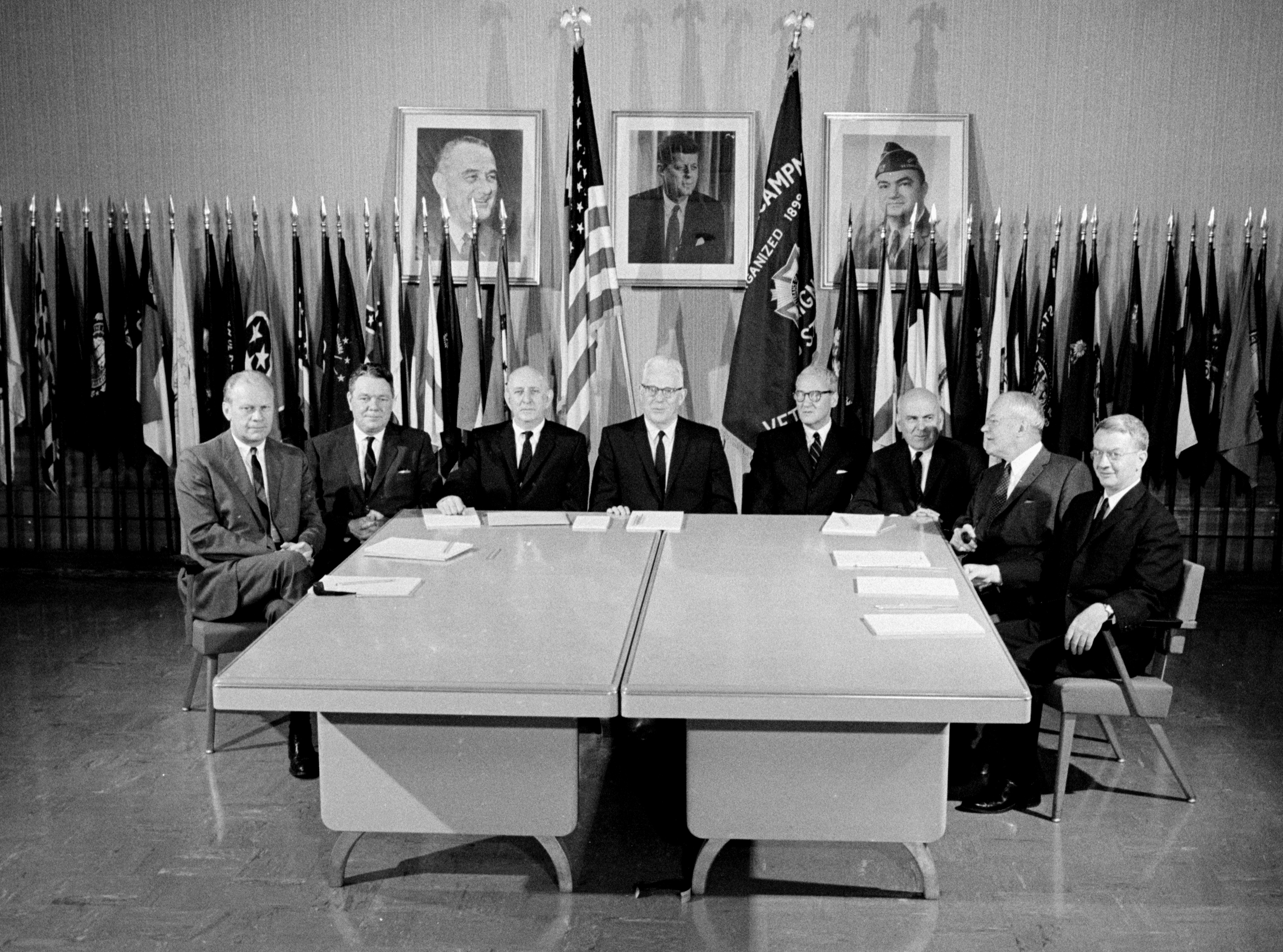
Earl Warren did not want to serve. He had refused twice. The Chief Justice of the United States should not participate in executive branch investigations — it violated separation of powers, it compromised the Court's independence, it was simply wrong.
Then Lyndon Johnson called him to the Oval Office.
PARTICIPANTS: PRESIDENT JOHNSON, CHIEF JUSTICE WARREN
TRANSCRIPT DECLASSIFIED 1993
Warren left the Oval Office with tears in his eyes. He had been maneuvered. He knew it. Johnson had framed the investigation not as a search for truth but as an act of national security. The conclusion was predetermined: a lone gunman, no conspiracy, no foreign involvement. Anything else meant nuclear war.
Warren understood what he was being asked to do. He did it anyway.
Before the Commission was even formed, before Warren was coerced, the conclusion had already been mandated. Deputy Attorney General Nicholas Katzenbach — acting in place of Robert Kennedy, who was paralyzed with grief and something else — sent a memo to Bill Moyers at the White House:
It is important that all of the facts surrounding President Kennedy's assassination be made public in a way which will satisfy people in the United States and abroad that all the facts have been told and that a statement to this effect be made now.
1. The public must be satisfied that Oswald was the assassin; that he did not have confederates who are still at large; and that the evidence was such that he would have been convicted at trial.
2. Speculation about Oswald's motivation ought to be cut off, and we should have some basis for rebutting thought that this was a Communist conspiracy or (as the Iron Curtain press is saying) a right-wing conspiracy to blame it on the Communists...
3. The matter has been handled thus far with neither combativeness nor a distorted quasi-judicial posture.
Three days after the assassination, before any investigation had occurred, the Deputy Attorney General had written the conclusion: Oswald was the assassin. He acted alone. The public must be satisfied.
The Commission's job was not to discover the truth. It was to satisfy the public with a predetermined narrative.
Robert Kennedy said almost nothing. The man who had run the most aggressive investigation in Justice Department history, who had pursued the Mafia with messianic zeal, who had demanded to know why the CIA couldn't kill Castro — he went quiet.
He did not demand answers. He did not insist on leading the investigation. He did not use any of the resources at his command to find his brother's killers.
Why?
The answer was buried in the files Robert Kennedy knew existed. The CIA-Mafia plots. The Castro assassination attempts. The meetings with Giancana and Roselli and Trafficante — the same mobsters Bobby was prosecuting. If the Commission looked too closely at who might have wanted Kennedy dead, they would find the operations that Bobby himself had supervised.
To investigate his brother's murder was to expose his own involvement in the plots that may have inspired it. The serpent was eating its tail. Bobby's silence was not grief. It was self-preservation.
Allen Dulles attended more Commission meetings than any other member — more than Warren himself. He reviewed more documents. He interviewed more witnesses. He steered more discussions.
He also withheld more evidence than any other person in Washington.
- The CIA-Mafia assassination plots against Castro (ZRRIFLE, MONGOOSE executive action)
- The Agency's use of Trafficante, Giancana, and Roselli — figures connected to Ruby
- Oswald's possible intelligence connections (defector repatriation without debriefing)
- The Mexico City surveillance discrepancies (the photograph that wasn't Oswald)
- David Ferrie's connections to both Oswald and anti-Castro operations
- The CIA's own internal suspicions about Cuban exile involvement
When the Commission asked the CIA if Oswald had any intelligence affiliations, the Agency said no. Dulles knew better. When the Commission asked about plots against Castro, the Agency said nothing. Dulles knew everything.
At one executive session, Dulles explained to his fellow commissioners how intelligence agencies worked:
DULLES: ...the record of a man who is a secret agent, his background and personality and what he has done, is kept very secret.
WARREN: Would an agent be instructed to tell his principal that he was not an agent?
DULLES: Absolutely. I would think so.
WARREN: And he would be told to deny it?
DULLES: He would be told to deny it.
McCLOY: Even to the Commission?
DULLES: I would think that under any circumstances he would be told to deny it.
Dulles was explaining, in plain language, that the CIA would lie to the Commission. He was on the Commission. He said this to their faces. And no one asked the obvious follow-up: Are you lying to us now?
The Commission had a problem. The Zapruder film showed Kennedy and Connally reacting to shots in a timing sequence that didn't work. If Oswald was the lone shooter, firing a bolt-action rifle from the sixth floor, he couldn't have fired fast enough to inflict all the wounds — unless some of the wounds came from the same bullet.
And so the single-bullet theory was born. One bullet, entering Kennedy's back, exiting his throat, entering Connally's back, exiting his chest, passing through his wrist, and lodging in his thigh. Seven wounds. One bullet.
The bullet — Commission Exhibit 399 — was found on a stretcher at Parkland Hospital. It was nearly pristine. Almost undamaged. After allegedly passing through two men and striking bone multiple times.
Governor Connally never believed the single-bullet theory. Neither did his wife, who was sitting next to him. Neither did the Parkland doctors who treated both men. Neither, privately, did several Commission members.
But it was the only way to make the evidence fit the lone-gunman conclusion. So the single-bullet theory became fact. And the Report moved on.
Gerald Ford, the Commission member who was secretly reporting to J. Edgar Hoover, had one lasting contribution to the Report. He changed a single phrase.
The original draft stated that a bullet had entered Kennedy's back "at a point slightly below the shoulder." Ford changed it to "the back of the neck."
This was not a minor edit. The autopsy photographs showed the wound well below the neck, in the upper back. The death certificate placed it there. The FBI report placed it there. Even the bullet holes in Kennedy's jacket and shirt placed it there.
But a bullet entering the back couldn't exit the throat and then enter Connally — the angle was wrong. Only a bullet entering the "back of the neck" could travel the trajectory the single-bullet theory required.
Ford moved the wound. On paper, with a pencil. And the Commission published it as fact.
I have now reviewed the full body of evidence and testimony. I find the conspiracy theories unpersuasive for the following reasons:
1. Occam's Razor. The simplest explanation is usually correct. Oswald had motive (political alienation), means (the rifle), and opportunity (employment at the Book Depository). No additional actors are required to explain the evidence.
2. The Witnesses. Those claiming multiple shooters are largely unreliable — confused by the acoustics of Dealey Plaza, influenced by subsequent media coverage, or seeking attention. The credible witnesses support the sixth-floor origin.
3. Conspiracy Logic. A conspiracy of the scope alleged would require dozens of participants maintaining perfect silence. Human nature does not support this. Someone would have talked by now.
4. Ruby. While his mob associations are troubling, his emotional instability is well-documented. He saw an opportunity and took it. This is characteristic of his personality, not evidence of coordination.
I believe we have conducted a thorough investigation. The evidence supports the conclusion we are preparing to publish. I see no reason to delay or to pursue the more speculative allegations that have been raised.
History will vindicate this Commission.
The Warren Commission Report was published on September 24, 1964. 888 pages of conclusions. Twenty-six volumes of supporting testimony and evidence.
26 VOLUMES — 17,000+ PAGES — 552 WITNESSES
The truth buried under the weight of paper.
The conclusions: Lee Harvey Oswald acted alone. Jack Ruby acted alone. There was no conspiracy. The shots came from behind, from the sixth floor. One gunman, one rifle, one implausible bullet.
Senator Richard Russell refused to sign. He was eventually persuaded, but told an aide: "I don't believe it, and I don't think you'll ever get me to believe it."
Congressman Hale Boggs would later tell journalists he had "strong doubts" about the single-bullet theory and Hoover's handling of the investigation. In 1972, his plane disappeared over Alaska. The wreckage was never found.
Allen Dulles said nothing publicly. He had done his job. The questions that could have exposed the Agency — the plots, the Mafia connections, the Cuban operations — were never asked. The man Kennedy had fired had written the final chapter of Kennedy's story.
He was right. For a decade, the Warren Report was treated as settled history. It took the Church Committee, the House Select Committee on Assassinations, and a generation of researchers to begin unpacking what had been hidden in those twenty-six volumes.
By then, most of the witnesses were dead. Most of the evidence was "lost." Most of the principals had taken their secrets to the grave.
The Commission had done its job. The public was satisfied. The truth was buried.
And in Georgetown, an old man with a pipe watched the news coverage of the Report's release. He had built an intelligence agency, toppled governments, ordered assassinations. He had investigated the murder of the president who fired him. He had ensured that certain questions were never asked.
Allen Welsh Dulles would live another five years. He never spoke publicly about the Commission's work. He never acknowledged what he had concealed. He died in 1969, his secrets intact, his legacy secure.
The memo that bears his name — the one that started this manuscript — was never found in his papers. Perhaps it never existed. Perhaps it was destroyed. Or perhaps it is still waiting, in some forgotten archive, for someone to read it and understand what was done in those twenty-six volumes, and why.
[ hover or tap redactions to reveal ]